
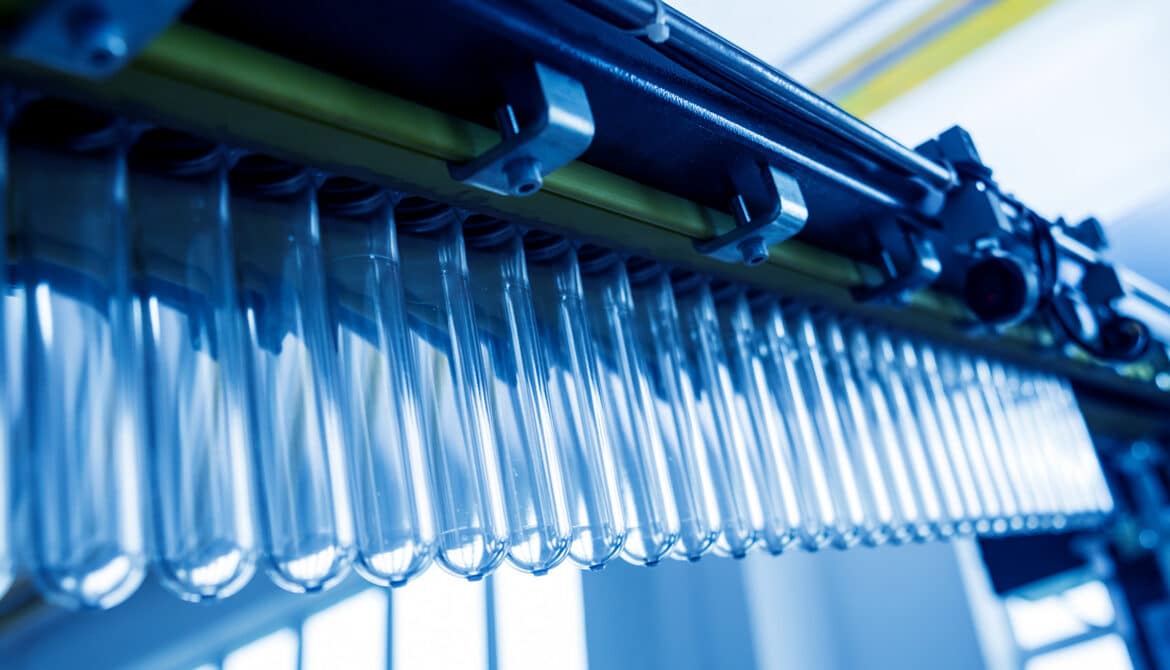
In reheat stretch blow molding, temperature matters. A lot. Preforms need the right thermal profile before they’re stretched and blown into bottles. Too hot, too cold or unevenly heated, and the material may not stretch and distribute as intended. The result can be inconsistent wall thickness, bottle performance issues and time spent adjusting a process without knowing exactly what’s wrong.
But here’s the challenge: What you measure on the outside of a preform doesn’t necessarily tell you what’s happening on the inside.
That difference matters because the inner surface of the preform wall must stretch farther than the outer surface during bottle formation. Knowing whether the inner wall has reached the appropriate temperature is critical to understanding how the material will behave.
That’s why PTI developed PreTemp®, a handheld temperature measurement system designed to give processors a more complete picture of preform heating.
Rather than relying on a single external temperature reading, PreTemp can capture measurements at up to 16 points along the preform’s length, from near the finish to the endcap. When used properly, it can also measure temperatures at corresponding points on the exterior surface.
The result? A much clearer picture of how heat is distributed along the preform and how temperatures differ between its inner and outer surfaces.
And that information can help processors make better decisions before a preform ever becomes a bottle.
More Than Skin Deep
During reheat stretch blow molding, infrared ovens heat preforms before they are stretched and blown into their final shape. The objective is to establish a thermal profile that allows the material to stretch and distribute appropriately.
But preforms don’t heat uniformly through their walls.
A conventional machine pyrometer typically measures temperature at a single location on the outside of the preform. That’s useful information, but it represents only one part of the thermal picture.
PreTemp takes measurement to the next level.
By evaluating temperatures along the preform’s length and comparing its inner and outer surfaces, processors can see where heat has penetrated the material and where differences exist.
Why is that important?
Consider a preform that appears to have reached the target surface temperature but remains cooler on the inside. That temperature difference can influence how the material stretches and ultimately how it distributes within the finished bottle.
With a more complete thermal profile, processors can better understand whether adjustments to individual oven heating zones might improve material distribution.
The information becomes especially useful for containers that require preferential heating, such as oval bottles.
In these applications, the preform is intentionally heated differently around its circumference to achieve the desired material distribution. By rotating the preform in 90-degree increments during measurement, processors can evaluate temperature differences around its circumference, including at the inner and outer surfaces.
Together, these measurements provide a more comprehensive view of the preform’s thermal profile and help operators assess how effectively their heating strategy is working.
From Development to Production
One of the biggest challenges in blow molding isn’t necessarily developing a successful process. It’s reproducing that process consistently.
A container may perform exactly as intended during initial development, only to behave differently when production moves to a larger commercial machine.
Why?
For starters, the two machines may not measure preform temperature in the same way.
Pyrometers can be positioned at different locations or operate at different wavelengths. Oven hardware, including infrared lamps and reflective components, may also differ. As a result, identical temperature readings on two machines don’t necessarily mean the preforms have the same thermal profile.
That’s where an independent measurement becomes valuable.
PreTemp allows processors to compare actual preform temperatures across different machine platforms rather than relying solely on each machine’s instrumentation.
For example, a team transferring a validated bottle design from a development machine to a commercial production line can compare temperatures at corresponding locations along the preform, including its inner and outer surfaces.
If those thermal conditions match, the team has greater confidence that the heating portion of the process has been reproduced. If bottle performance still differs, attention can shift to other variables, such as blowing pressure and timing.
The same approach can be useful when production moves between facilities or geographic locations.
Instead of starting from scratch with every equipment change, processors have a consistent temperature reference to help establish and validate operating conditions.
Better Data, Better Decisions
The value of PreTemp goes far beyond collecting more temperature readings. It’s knowing what to do with them.
Consider a production line that begins producing bottles with inconsistent material distribution.
An operator might respond by increasing oven power, changing heating zones or adjusting other blow-molding parameters. But without a clear understanding of the preform’s thermal condition, those changes can become a process of trial and error.
PreTemp provides another way to investigate.
By identifying temperature differences along the preform and between its inner and outer surfaces, processors can make more targeted adjustments to the heating profile.
This information can be useful when introducing new materials, too.
For example, darker recycled PET can absorb infrared energy differently than conventional resin, affecting how heat penetrates the preform wall. A surface temperature reading alone may not reveal whether the inner wall has reached the temperature needed for consistent stretching.
PreTemp helps processors evaluate those differences and determine whether oven adjustments are needed to achieve a comparable thermal profile.
The same principle applies to other materials used in stretch blow molding, including polypropylene (PP) and Tritan, which can present additional processing challenges. Materials with narrow processing temperature windows make accurate thermal measurements especially valuable.
And there’s another potential benefit: energy efficiency.
More heat isn’t always the answer to a bottle performance problem. By understanding where heat is needed and how effectively it penetrates the preform wall, processors can make more deliberate oven adjustments rather than simply increasing power.
Measure first. Adjust with purpose.
A Troubleshooting Tool in Your Hand
Anyone who has spent time troubleshooting a blow-molding process knows that the obvious answer isn’t always the right one.
A bottle defect may appear to be related to blowing pressure, material characteristics or oven settings. And when several parameters are adjusted at once, determining which change actually solved the problem becomes even harder.
PreTemp helps narrow the possibilities.
Because the system is handheld, it can be used on the production floor to evaluate preforms, compare thermal conditions and investigate process changes.
That makes it useful in several situations: validating a new container design, transferring production between machines, introducing a different resin or troubleshooting a line that has begun behaving differently.
It can also provide important insight when working with preform designs that aren’t fully optimized or materials with limited strain-hardening behavior.
In each case, the goal is the same: Replace assumptions with measurements that help identify the variables worth investigating.
PreTemp doesn’t eliminate the complexity of stretch blow molding. But it gives processors another practical tool for understanding how preform heating affects what happens downstream.
And when teams can identify a potential problem sooner, they can spend less time making adjustments that don’t address the underlying issue.
Measure What Matters
At PTI, understanding the complete packaging system is central to how we approach container development, testing and process optimization.
PreTemp brings that same approach to preform temperature measurement.
A single surface reading can be useful. But a more complete thermal profile, including temperature differences along the preform and through its wall, provides additional insight into how the material is prepared for stretching and blowing.
That information can help processors evaluate heating strategies, transfer processes between machines, investigate material changes and troubleshoot bottle performance.
The objective isn’t more data for its own sake. It’s better information that leads to better process decisions.
Ready to look beyond the surface? Talk to PTI about PreTemp and how more complete preform temperature data can support your blow-molding process. Get in touch.


