
Convenience, sustainability and consumer expectations are reshaping one of packaging’s smallest but most important components.
For decades, caps and closures had a relatively simple job: keep products secure until consumers were ready to use them. Today, that’s no longer enough.
Increasingly, closures are expected to preserve freshness, support portion control, improve accessibility, enhance sustainability and create a better consumer experience. Meanwhile, closures must be affordable and compatible with existing manufacturing systems.
We caught up with PTI’s Business Development Manager, Franklin Villalona, who identified a shift that is forcing teams to think differently about the role closures play. They’re no longer stand-alone components, but part of a larger system.
In many ways, one of packaging’s smallest components has become one of its most complex, he points out.
“We’re seeing closures evolve from a functional necessity into an important part of the overall packaging experience,” he says. “Consumers expect convenience, brands want differentiation, and manufacturers need solutions that can scale. Those expectations all have to coexist.”
Beyond Open and Close
Historically, closure development has focused on access and containment. If a package opened reliably and maintained product integrity, it was considered successful. Today’s consumers expect more.
Resealability has become a baseline expectation across many categories. Consumers want products that stay fresh longer and fit seamlessly into their daily routines. At the same time, brands continue to pursue sustainability goals and seek opportunities to stand out in increasingly crowded food and beverage markets.
The challenge, of course, is that these priorities don’t always align. Adding functionality can introduce complexity. Improving sustainability can affect cost. Enhancing convenience can create manufacturing challenges.
“Packaging has always involved tradeoffs,” Villalona says. “The question becomes: How do we deliver more value to consumers without introducing unnecessary complexity into the system?”
That’s where closure innovation is beginning to accelerate.
Designing for the Real World
At PTI, conversations around closures increasingly center on performance beyond the package.
- How does a closure perform after its fifth use?
- Does it maintain freshness? Is it intuitive for consumers?
- Can it be manufactured at scale?
- What happens when it enters the recycling stream?
These questions are becoming just as important as torque specifications and dimensional tolerances. “The future of packaging isn’t about optimizing a single component,” Villalona says. “It’s about understanding how every component behaves as part of a system.”
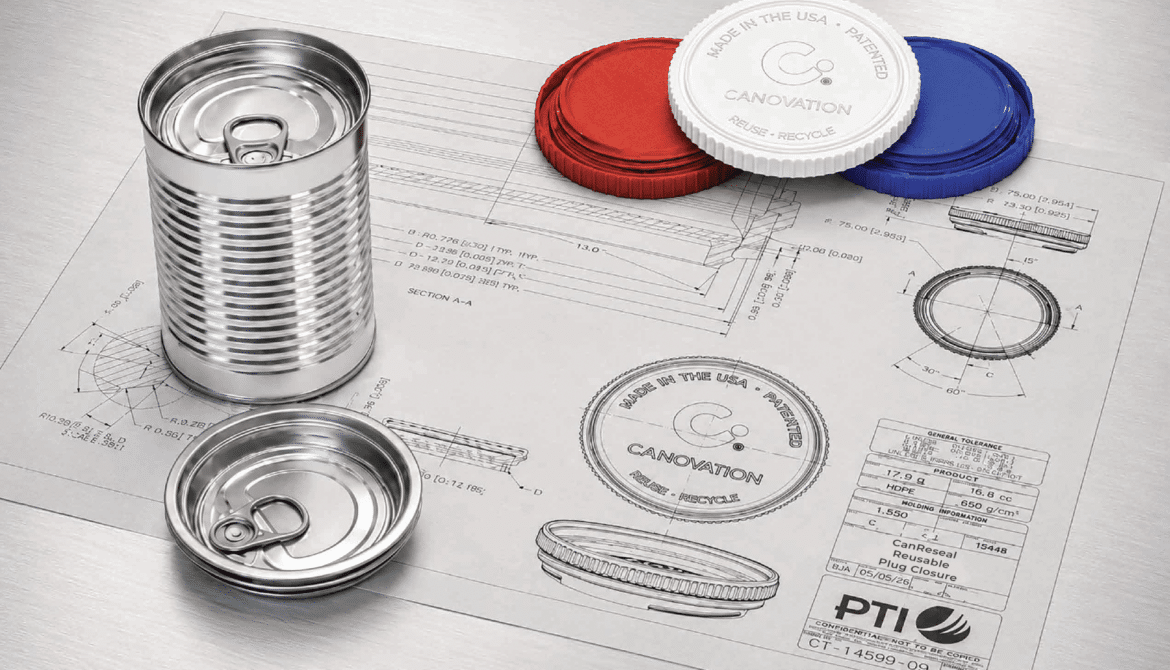
System-level thinking is driving new approaches to closure product design across the industry. PTI is currently collaborating with Canovation on the development of a reusable closure designed to complement the company’s CanReseal® architecture for food and pet food applications. “For metal packaging specifically, there is growing interest in extending the low-cost reseal functionality traditionally associated with glass and plastic packaging into infinitely recyclable metal formats,” says Daniel Zabaleta, Canovation’s Chief Technology Officer.
Canovation’s CanReseal technology adds threads to the common easy-open food can end, allowing a threaded closure to screw in for air- and liquid-tight resealability. PTI’s collaboration with Canovation is focused on delivering a highly durable, dishwasher-safe closure, providing consumers with a more functional version of snap-on lids that many currently use today.
The focus reflects a broader trend: extending convenience features typically associated with plastic and glass into other packaging formats without sacrificing manufacturability or sustainability objectives.
“Our work on the reusable closure is intended to complement that architecture with a solution engineered for practical use, repeatable reseal performance and consumer convenience,” Villalona says. “We see strong potential for CanReseal to become a leader in the market for food packaging, and we’re excited to be part of that journey.”
The Five Drivers of Packaging Innovation
According to Canovation and PTI, packaging innovation is increasingly shaped by five drivers:
- Economics
- Regulation & Compliance
- Ecology & Sustainability
- Branding & Marketing
- Consumer Experience
Together, these forces are redefining what packaging is expected to do, including how caps and closures can move beyond simply providing access and product security. Regulators continue to place greater emphasis on recyclability and material recovery. Brands are looking for ways to create differentiation while managing costs. Consumers continue to demand convenience. And manufacturers need solutions that work within existing production environments.
It’s a balancing act — one that’s becoming more challenging as packaging systems grow more interconnected. “Consumers will continue to pay for added value and convenience,” says Villalona. “The industry’s challenge is delivering those benefits in a way that’s scalable, sustainable and affordable.”
Looking Ahead
What will closures look like five or 10 years from now? The answer is likely: more intelligent, more functional and more integrated into the overall packaging experience.
Future closure systems may incorporate dispensing capabilities, improve product preservation, support portion control or enable entirely new forms of consumer engagement. Increasingly, they’ll also need to perform across emerging distribution channels, from e-commerce fulfillment to autonomous delivery systems.
“What we call a closure today may become something entirely different tomorrow,” Villalona says.
That evolution is already underway.
At PTI, the role is not simply to develop closures. It’s to help brands and manufacturers understand how closures interact with materials, products, consumers and manufacturing systems in the real world. Because in modern packaging, the question is no longer whether a package opens. It’s what happens after.
Curious about what’s next for your packaging system? Let’s start the conversation. And if you plan on attending Pack Expo International in Chicago, Oct. 18-21, stop by and see us. We’re hosting the Canovation team and have other exciting announcements in store. See you at booth W-46110!


