
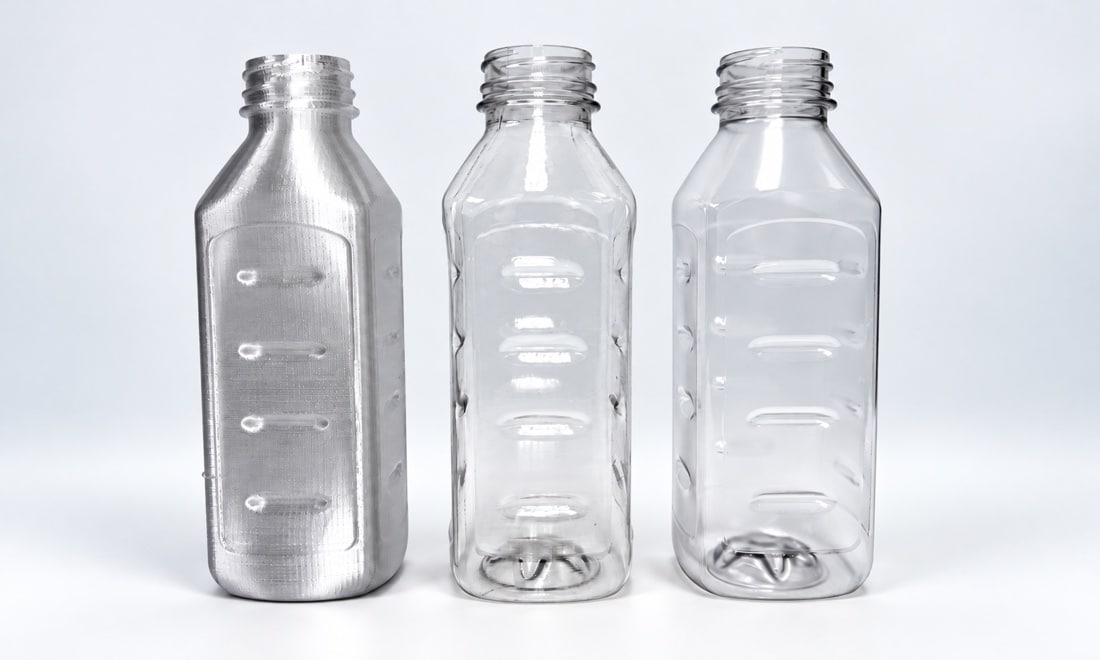
PTI is expanding its 3D printing capabilities to help package developers move from an idea on screen to a prototype in hand — and make better decisions, faster.
A dairy container needs to be lightweighted, but the brand doesn’t want structural ribs interfering with valuable label space. Where should the ribs go? How many are necessary? How deep should they be?
A ketchup bottle looks good on screen. But will it dispense properly with the standard closure? Will the sidewall dent or crease? Will bottles shingle as they move down a conveyor?
Or consider a 210-ounce laundry detergent container. How does the handle feel? Will the existing label fit? And when the package is placed alongside competitors, does it have the right shelf presence?
These are very different package development challenges with something important in common: A physical prototype can answer questions that are difficult to resolve on a screen alone.
At PTI, we’re expanding 3D printing capabilities so you can answer these types of questions much earlier in the package development process. This year, we have enhanced our 3D printing capacity and added multimaterial printing capabilities, including the ability to produce:
- Solid and hollow models
- Watertight large-format packages
- Caps and closures
- Functional parts for production equipment
Here, we caught up with Sumit Mukherjee, chief technology officer at PTI, to talk about where 3D printing fits into package development — and how having a 3D printed package prototype in your hands can change the process.
Q:Why is speed such an important part of the 3D printing conversation?
Package development can take many different paths, and there is a need for fast physical prototypes that allow you to make decisions scientifically and accurately.
It really comes down to time, efficiency and cost. How quickly can we take something from a concept on screen to a prototype you can actually hold, fill, drop, squeeze, dispense from or top load? The sooner we can answer those questions, the sooner we know whether we’re moving in the right direction.
Producing a conventional part can take a couple of weeks or more. When 3D printing is used strategically and supported by the right infrastructure, we can evaluate key attributes earlier, make adjustments sooner and move the right design toward production more efficiently.
Q: What can you learn from holding a prototype that you can’t necessarily learn from a rendering?
Having something in your hand always has benefits compared with a photorealistic rendering.
Does the package have the right look and feel? How does the label fit? Does it topple over easily? Does it dispense properly? Those are questions you can begin answering with a physical prototype.
This becomes especially useful as containers are lightweighted for sustainability. You may need to introduce ribs or other geometry to achieve the necessary performance. You can simulate those features, but every application — top load, squeeze and where or how the package is squeezed, for example — can require separate analysis.
A couple of 3D-printed prototypes can potentially answer many of those questions faster and more economically.
Q: So is 3D printing an alternative to simulation?
Not necessarily. In many cases, 3D printing and simulation work best together. Go back to that lightweight dairy container. The customer doesn’t want ribs taking up valuable label space, but we still need to figure out where those ribs should go, how many we need and how deep they should be.
Say we have four possible designs and three different performance attributes we want to evaluate. We could run multiple simulations for every design. Or we could print prototypes of those four designs at two different weights, put them through some initial testing and quickly see which options show the most promise.
From there, we can use simulation more selectively — to benchmark what we’re seeing in the physical testing, fine-tune a promising design or help us find another solution if none of the prototypes hits the performance target. It’s really about using the right tool at the right point in the process.
Q: How close can a 3D-printed prototype get to an actual production package?
There are a couple of approaches. We can 3D print the hollow package itself, or we can use 3D printing to produce a mold that allows us to manufacture a part that more closely resembles a conventionally produced package.
That gives us a lot more to work with. Take a mayonnaise or ketchup container. We can fill it, add a standard closure and see how it actually performs. Does it dispense properly? Does the container dent or crease? How does it hold up under vacuum or top load? We can even see how the packages behave as they move down a conveyor. A prototype made from a 3D-printed mold lets us start answering those questions before investing in conventional tooling
Q: What does large-format 3D printing add to the equation?
We can now print both small- and large-format parts, including large hollow models that are watertight. Think about a 210-ounce laundry detergent container. A customer might want to evaluate its ergonomics, determine whether an existing label can be applied correctly and understand how the package will look next to competitors.
We can print that large hollow container, apply the label, add the dosing and vent caps and physically place it on a shelf. That gives the customer another way to gather consumer feedback rapidly without relying solely on a digital store-shelf rendering.
Q: Beyond containers, what else can PTI produce with 3D printing?
We can print quite a bit — solid and hollow models, caps, closures and even functional parts for our production equipment.
Say we’re doing a sample run and need to adapt a piece of equipment for a different neck finish. Instead of waiting for a custom metal part to be made, we may be able to 3D print what we need and keep the project moving. It won’t have the durability of metal, but for a short run, it can do the job. That’s another place where 3D printing can save us time and give us more flexibility.
Q: Are there limitations package developers should understand?
Absolutely. 3D printing isn’t a panacea for every package-development concern. Rapid prototypes can have some divergence in dimensions and volume, and there can be limitations in reproducing certain features.
There are also applications where current material technology isn’t sufficient. A hot-fill container is one example. There are also questions involving carbonated soft drink containers, such as evaluating a new base for stress-crack resistance or determining whether it will prevent base rollout during thermal stability testing, where rapid prototypes are not yet fully feasible.
But the technology continues to evolve. If we can create a prototype close enough to a production part to answer 80% to 90% of the questions in roughly one-third of the time, that represents a significant productivity gain.
Q:Where does PTI see the greatest opportunity for 3D printing in package design and development?
The key is to know how and when to use 3D printing as part of the larger package-development process. PTI has integrated design, simulation, tooling manufacture, injection molding, blow molding and testing infrastructure. That gives us the ability to determine the right approach for the question we’re trying to answer.
Sometimes that’s a simulation. Sometimes it’s a directly printed prototype. Sometimes it’s a package manufactured using a 3D-printed mold. And sometimes we need to move into more conventional development and testing.
When 3D printing is used strategically, it can drive faster, more accurate decision-making. And as the technology continues to advance, the gap between rapid prototypes and production-like prototypes should continue to narrow.
Test Before You Tool
Before investing in production tooling, make sure the package is headed in the right direction. PTI can use 3D printing to create prototype molds and sample packages so your team can evaluate look, feel, squeezability and other critical attributes earlier — without the cost and commitment of production tooling.
Have a package concept you want to put to the test? Contact PTI to explore the right prototyping approach for your project.


