
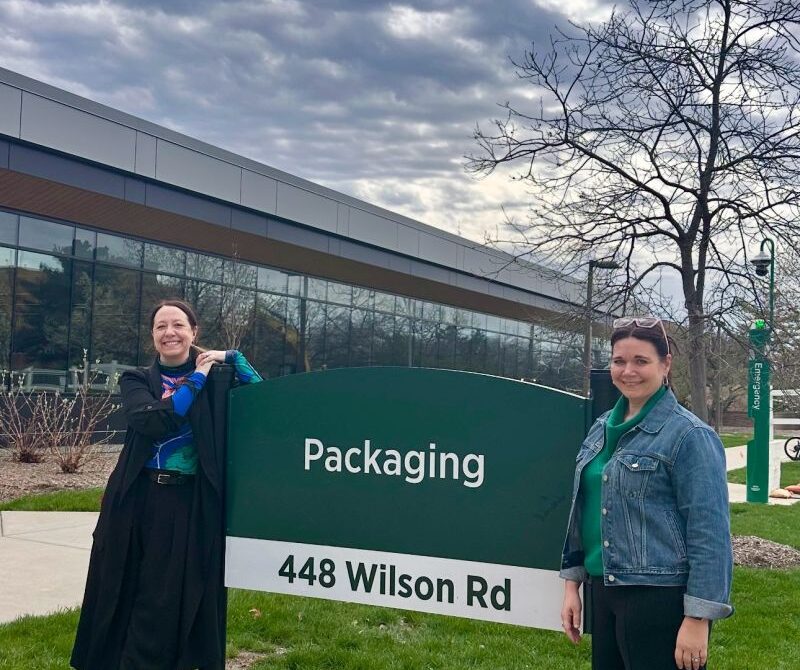
When we visited the Michigan State University School of Packaging recently, I had the opportunity to deliver a guest lecture to advanced students and future engineers about something that’s changing quickly across the industry: Association of Plastics Recyclers (APR) compliance.
It used to be a best practice — something teams worked toward as part of broader sustainability goals. But as I explained to students, this is no longer the case. What it means to design packaging for recyclability is constantly evolving, and PTI is on the front lines as an APR-preferred lab and technical resource.
The reality is, there are a lot of moving parts to navigate.
Extended Producer Responsibility (EPR) laws are expanding. Fee structures are taking shape, and packaging designs are starting to become directly tied to cost. Meanwhile, materials, labels and design features create challenges, not to mention leading to financial penalties, redesigns or lost market opportunities.
There’s a lot at stake — a lot for our future engineers to learn, and for our industry to understand and adopt.
For packaging teams, the message is clear: APR compliance is no longer optional and it’s ever-changing, and PTI’s labs carry APR’s stamp of approval to provide essential guidance.
So, where do companies get stuck with APR compliance, and what are the most effective ways to address it? Let’s dig in.
Stuck in Compliance ‘Muddy Waters’
Even with growing awareness, APR compliance can still feel like a moving target that’s really difficult to pin down. Many teams begin with a basic question: Is this package compliant?
The answer is rarely straightforward. Determining whether a package meets APR guidance often requires understanding how individual components interact within a recycling system, not just how they perform in isolation.
You can see how confusion builds up into an operational obstacle.
Teams may not know whether testing is required or what elements of a design could lead to failure. A label choice, a colorant or a multilayer structure may seem minor at the design stage, yet have a measurable impact once that package enters sortation and reprocessing.
Often, packaging is designed based on specs or supplier input, without fully understanding how it will behave once it hits the recycling stream. This gap between design and real-world performance is where problems can start.
Beyond the Checklist: System Redesign
APR compliance is often approached as a checklist. In reality, it is a system-level challenge.
We know a package does not move through recycling as a collection of independent parts. Materials, additives and structures interact as they pass through sorting, grinding, washing and reprocessing. A design that appears sound in isolation may behave very differently under those combined conditions.
This is where system-level thinking becomes critical.
Recyclability isn’t just about what’s on paper. It involves what happens once a package enters the system. Materials react to heat and stress, behave differently during sorting and can impact the quality of what gets recovered. All those effects need to hold up in testing and real-world operations.
The bottom line: Looking at the full picture helps bridge the gap between design and what actually works in recycling.
The Time for APR Is Now
One of the most effective ways to manage APR compliance is to address it early in the design process.
That principle was reinforced during our visit to MSU’s School of Packaging, where we introduced students to APR guidance, Critical Guidance testing and the fundamentals of designing for recyclability.
The focus was on helping future engineers understand that recyclability is not a final checkpoint. It is a design input. The same approach applies across the industry.
When recyclability is considered at the outset, design paths tend to be more efficient. Potential issues are identified sooner, reducing the need for later adjustments. Testing becomes more targeted, and the likelihood of unexpected outcomes decreases.
When it’s addressed later, the process often becomes more complex. Changes may require redesign, additional validation or adjustments to materials and components that have already been specified.
And there’s a cost of getting it wrong.
As APR guidance continues to evolve and EPR frameworks take hold, the consequences of non-compliance are becoming more tangible. This shifts APR compliance from a purely sustainability-driven objective to a business consideration. Decisions made during design can influence not only environmental outcomes, but also cost structures and operational efficiency.
APR Compliance Playbook
APR compliance is becoming more structured, closely tied to policy and central to packaging performance.
For companies navigating this landscape, the challenge goes beyond understanding guidelines. We must apply them early and effectively within our systems.
If you’re still asking, “What does all this mean?” We have good news. APR compliance does not have to feel like the great unknown. With the right partner, it becomes a defined process that reduces risk, improves efficiency and supports better performance across the full lifecycle of a package.
As an APR-preferred lab, PTI is positioned to help companies close that gap, and our role extends beyond testing. We participate in APR technical committees and collaborate with recyclers and industry stakeholders. Yes, we are a validation and compliance resource. But more importantly, we’re a partner throughout the development process.
In today’s environment, designing for recyclability is no longer just about meeting guidelines. It is about getting it right the first time. We’ve got the playbook.


