
Why COC and HDPE are redefining thermal packaging performance
Hot-fill packaging has often involved tradeoffs.
To survive high fill temperatures, containers require heat resistance and hold their shape. To protect sensitive products, packaging needs barrier performance. To support branding, containers have to appeal to customers visually with consistent clarity and surface quality, even after heat exposure. And to scale, packaging must run reliably on high-speed lines without slowing production.
Historically, packaging materials have forced engineers to prioritize some of these needs at the expense of others. Heat resistance often came at the cost of clarity. Barrier performance added complexity. Visual appeal introduced processing risk. The result was a series of compromises designed to manage failure rather than eliminate it.
But we know, as products become more sensitive, shelf-life expectations extend and production systems become more integrated. The traditional tradeoffs between performance, appearance and manufacturability are no longer sustainable.
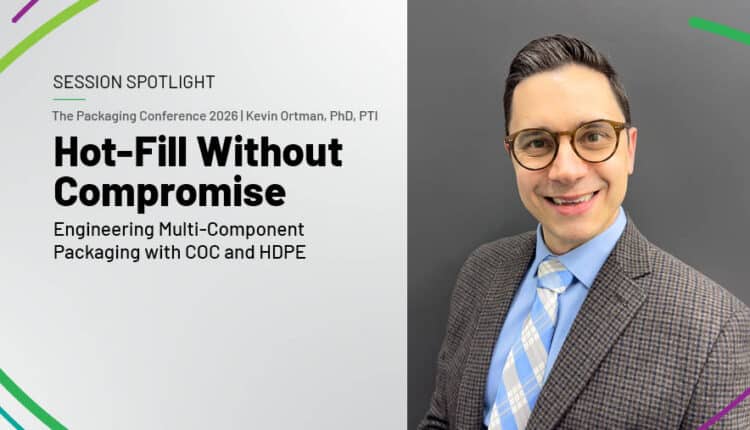
That tension is at the center of this year’s conversation at The Packaging Conference (TPC) and at the core of PTI’s work in multi-component material systems. Hotfill package performance is on the agenda for the 2026 conference in Austin, Texas, Feb. 9-11 at the AT&T Hotel & Conference Center. TPC is the kickoff to a roadshow year of high-level industry conferences for PTI, launching a series of upcoming events and industry appearances.
In his session at TPC, PTI’s Dr. Kevin Ortman, will explore how combining cyclic olefin copolymer (COC) with high-density polyethylene (HDPE) has the promise to help packaging teams move beyond tradeoffs to design hot-fill containers that perform across thermal, chemical, optical and operational demands — no compromises.
This shift is not about a single new material. It’s about engineering packaging as a system.
From materials to systems
The Packaging Conference serves as a forum for stakeholders across the packaging industry, bringing together material scientists, packaging engineers, brand owners, converters and equipment suppliers to look at how packaging challenges are evolving.
Sessions span topics from materials and barrier science to sustainability, manufacturing integration and process control, reflecting the way packaging development increasingly cuts across disciplines.
Dr. Ortman’s session on COC and HDPE multi-component structures, reflects this broader shift in how packaging teams are rethinking materials and systems in response to growing performance and manufacturing demands.
“What we’re seeing across the industry is a move away from optimizing individual properties and toward designing packaging as a system,” says Dr. Ortman. “Multi-component approaches like COC and HDPE allow teams to align thermal performance and manufacturability instead of trading them off.”
When heat meets packaging
When the heat is on, packaging is pushed to its limits. Hot fill exposes containers to high temperatures, then rapid cooling. This cycle can distort shapes, weaken seals and degrade clarity.
The net effect can be poor performance, increased waste and higher cost. Even small shape changes can ripple through manufacturing operations. Warping can affect closures. Paneling can disrupt labeling. Subtle distortion can interfere with stacking or automation.
Historically, engineers have managed these risks through process adjustments, tradeoffs and added inspection. That keeps lines running, but it also limits what the system can do. COC offers a different way forward with a set of properties that are unusually well aligned with hot-fill requirements.
“In the past, a lot of effort went into tuning the process to accommodate the material,” Dr. Ortman says. “With COC and HDPE, we’re able to start with materials that are already better aligned with the thermal and manufacturing realities of hot fill, which reduces complexity and improves consistency.”
COC resists softening at elevated temperatures and absorbs very little moisture. It doesn’t react with the product inside the packaging and can withstand environmental factors like heat, moisture and long storage times. Also important, it remains stable when exposed to heat so packaging holds its shape during and after filling.
But, as Dr. Ortman will explain in his session, the impact of COC is greatest when it is used as part of a multilayer structure rather than a standalone material.
COC with HDPE — Better Together
HDPE remains foundational to modern packaging because it performs reliably in manufacturing. It is tough, chemically resistant, scalable and compatible with existing extrusion and molding platforms around the world.
When COC is incorporated into an HDPE structure, each material contributes what it does best. HDPE provides structural strength and manufacturability. COC adds thermal stability. Together, they allow performance to be designed into the system rather than managed around its limitations.
This is the approach PTI is applying with global brands today by using multi-component material systems to improve packaging performance while maintaining manufacturing efficiency and scalability. In practice, that can mean more stable production, better protection for sensitive formulations and improved shelf presentation, without introducing unnecessary complexity into operations.
The result is not just better packaging, but more resilient and efficient packaging systems, an outcome PTI continues to validate through applied research, technical and analytical services, and real-world manufacturing partnerships.
The Full Package
Packaging is no longer evaluated only by whether it holds a product. It is evaluated by how well it protects formulations, performs on high-speed lines, supports brand presentation, achieves sustainability goals and scales reliably across global manufacturing networks.
As products become more complex and performance expectations rise, packaging decisions increasingly shape what is possible.
That is why this topic is gaining traction across the industry and why PTI is addressing it in an engaging discussion that will bring global case studies to the forefront at The Packaging Conference.
PTI’s role in this evolution is to connect material science to real manufacturing behavior — to understand how materials can perform as part of a system. That is the perspective Dr. Ortman will bring to the conference.
“The future of hot-fill packaging will not be defined by a single breakthrough material,” Dr. Ortman says. “It will be shaped by how well we integrate material science, manufacturing and performance into cohesive systems. COC and HDPE are one example of how that future is already taking shape and why this is a conversation worth joining.”
Train with PTI
We’re the PTI that consults with the world’s leading consumer products companies, and our commitment to hot-fill performance extends into applied engineering and industry education. In proprietary labs, we conduct hot-fill simulation testing to record metrics such as dimensional changes before and after filling. This helps reduce waste, prevent recalls and accelerate time to market.
For real-world examples of PTI’s engineering in action, check out our case studies with global brands like Dr Pepper Snapple Group and fairlife®, which highlight performance, manufacturability and sustainability outcomes.
Interested in more training?Enhance your technical knowledge with plastic packaging training, including Plastic Packaging for Hot-Fill / Aseptic Beverages Training. PTI also offers training on material compatibility and filling technologies for beverage packaging, giving teams insight into complex hot-fill behavior.


